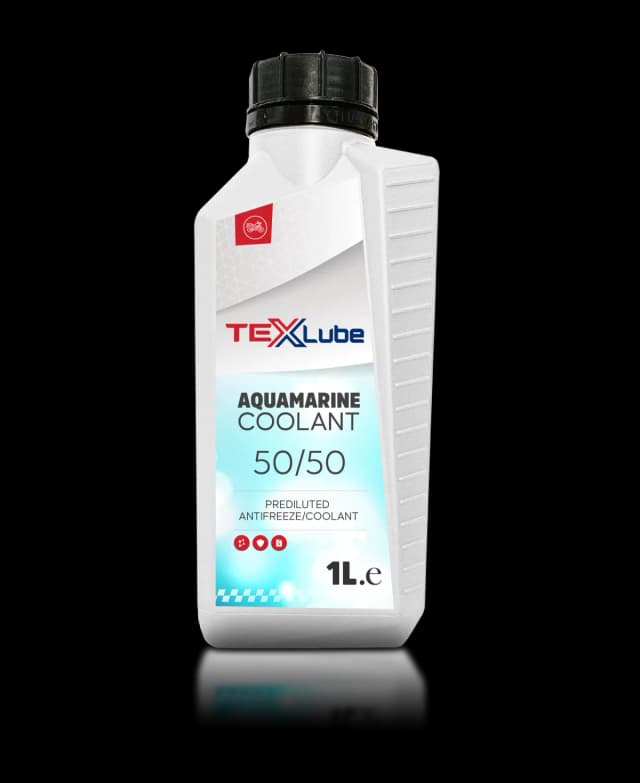
TexLube AQUAMARINE 30
TexLube AQUAMARINE 30 is a ready-to-use, phosphate-free, silicate-free, nitrite-free and borate-free ethylene glycol coolant made with organic corrosion inhibitors. It is designed to give exceptional wet sleeve liner cavitation protection and corrosion protection for all cooling system metals, on-road and off-road.
Manufactured in the UAE · ISO 9001:2015 certified production
Application
Recommended for passenger cars, heavy-duty diesel and gas engines and stationary engines regardless of fuel, and also for marine cooling systems where freeze protection is needed. Suits mixed fleets of light-duty and heavy-duty trucks.
Features & benefits
- Designed for engines with EGR and SCR technology, which can raise cooling system temperatures
- Eliminates the cost of supplemental coolant additives
- Fully compatible with other quality OAT and NOAT heavy-duty extended-life coolants
- Non-abrasive formula can improve water pump seal life
- Optimal hard water compatibility and less hard water scale
- Outstanding long-term elastomer compatibility
Aquamarine Coolant: full range
| Grade / variant | View |
|---|---|
| Coolant 33% | |
| Coolant 50% | |
| Coolant 100% |
Frequently asked questions
What is TexLube AQUAMARINE 30?+
TexLube AQUAMARINE 30 is a ready-to-use, phosphate-free, silicate-free, nitrite-free and borate-free ethylene glycol coolant made with organic corrosion inhibitors.
What is TexLube AQUAMARINE 30 used for?+
Recommended for passenger cars, heavy-duty diesel and gas engines and stationary engines regardless of fuel, and also for marine cooling systems where freeze protection is needed. Suits mixed fleets of light-duty and heavy-duty trucks.
Which performance levels does TexLube AQUAMARINE 30 meet?+
TexLube AQUAMARINE 30 meets or exceeds BS 6580, ASTM D3306.
What is the viscosity grade of TexLube AQUAMARINE 30?+
TexLube AQUAMARINE 30 is grade 30 (ethylene glycol-based).
Where can I download the technical data sheet (TDS) and safety data sheet (SDS) of TexLube AQUAMARINE 30?+
Both documents are available on this page. Use the "Technical data sheet (TDS)" and "Safety data sheet (SDS)" buttons above.